
You pull into your site on a warm Friday in July. The kids want the air conditioning on now. Someone else starts the microwave. Two minutes later the breaker on the pedestal trips and the rig goes dark. It is a classic first-weekend moment, and simultaneous appliance use may be the cause. Your RV has a power budget, and the active loads may have exceeded it.
Knowing the difference between 30-amp and 50-amp service fixes most of that. It also helps you book the right site the first time. Ready to plan your next trip? Find a location and reserve on the Happy Grounds campground finder, or call (508) 519-3200 and we will help you match your rig to the right site.
The short answer
A 30-amp RV hookup is a single 120-volt circuit rated at 30 amps. Multiply those together and you get 3,600 watts of total capacity.
A common 50-amp RV service is different in kind, not just size. It is a 120/240-volt split-phase connection with two separate 50-amp hot legs. Each leg supplies 120 volts at up to 50 amps, so each leg gives you 6,000 watts. Together that is up to 12,000 watts.
So 50-amp service is not “20 amps more.” It is roughly three and a third times the working capacity of a 30-amp hookup. That single fact explains why a big fifth wheel with two air conditioners needs a 50-amp site and a small travel trailer usually does not.
| 30-amp RV hookup | 50-amp RV hookup | |
|---|---|---|
| Voltage | 120V | 120/240V split-phase |
| Hot legs | One | Two |
| Amps available | 30 | 50 per leg |
| Total watts | 3,600 | 12,000 |
| Plug | TT-30, three prongs | NEMA 14-50, four prongs |
| Typical rigs | Smaller trailers, most single-AC RVs | Larger fifth wheels, coaches, multi-AC rigs |
How to tell the plugs apart
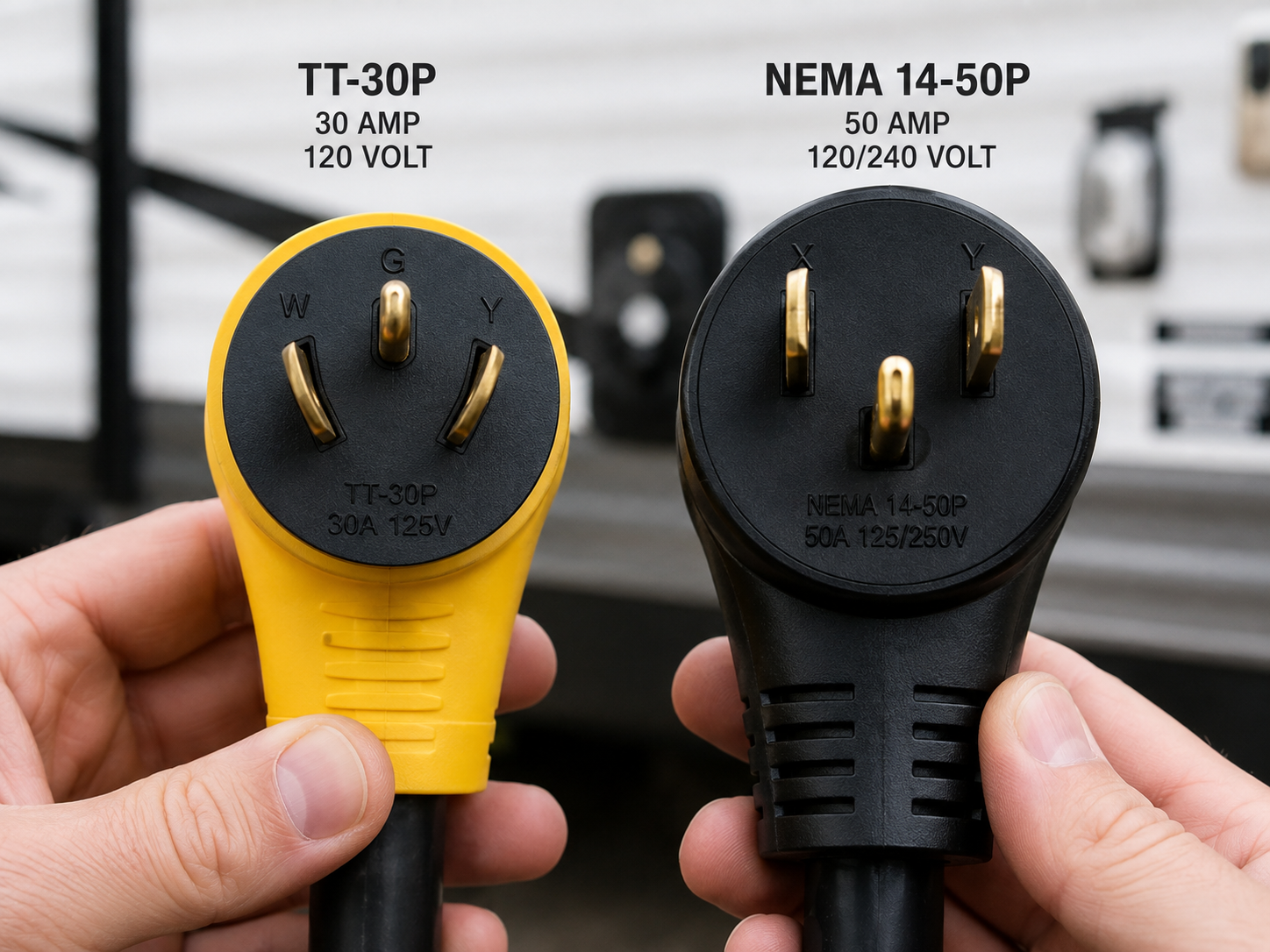
Look at the cord end on your RV before you look at the pedestal.
- TT-30P (30-amp): three prongs. Two angled blades and a round ground pin. One hot, one neutral, one ground. Despite the shape, it is not a 240-volt plug.
- NEMA 14-50P (50-amp): four prongs. Two hots, one neutral, one ground. This is the same style of receptacle used for many electric ranges at home.
- 20-amp household (5-15 or 5-20): the ordinary plug you know. Some sites offer this alongside the larger service, and it is enough for lights and a charger, not for air conditioning.
The prong count is a useful field check for standard RV receptacles. A three-prong TT-30 receptacle is 30 amps, while a four-prong 14-50 receptacle is 50 amps. Read the pedestal label and confirm the receptacle type rather than relying on appearance alone.
What each service actually runs
Numbers help more than opinions here. Rough draws for common RV appliances look like this, and your own model plate is the real authority.
| Appliance | Rough running watts |
|---|---|
| Rooftop air conditioner | 1,200 to 2,000 |
| Microwave | 900 to 1,500 |
| Electric water heater element | 1,200 to 1,500 |
| Coffee maker | 800 to 1,200 |
| Space heater on high | 1,500 |
| Hair dryer | 1,200 to 1,800 |
| Residential refrigerator | 400 to 800 |
| Converter or charger | 300 to 800 |
On a 30-amp hookup you have 3,600 watts total. One air conditioner plus a coffee maker plus a charging load already crowds the budget. Add a hair dryer and you are likely tripping a breaker.
On a 50-amp hookup you have 6,000 watts per leg. Two air conditioners can run while someone microwaves lunch. The catch is that your rig splits appliances across the two legs, so one leg can overload while the other sits nearly idle. If your panel keeps tripping on one side while the other is quiet, that is an imbalance, not a shortage.
Managing power on a 30-amp site
Most families camp comfortably on 30 amps with a little sequencing. Treat it like a stovetop with limited burners.
- Run the air conditioner first on hot afternoons. It is the biggest steady load.
- Switch the water heater and refrigerator to propane when the weather is hot and you want the electric headroom.
- Use high-draw items one at a time. Microwave, then coffee, then the hair dryer.
- Do a family huddle on arrival. Everyone should know that two heat-producing appliances at once is the usual culprit.
- Watch your voltage. On a hot, busy summer weekend in New England, park-wide demand can pull voltage down, and low voltage is harder on an air conditioner than a short outage.
Adapters and their real limits
Adapters solve fit. They do not create power. This is the single most misunderstood point in the 30 amp vs 50 amp conversation.
- 50-amp RV plugged into a 30-amp pedestal, using a 50A-to-30A adapter (often called a dogbone): you now have 3,600 watts total for the whole coach. Both legs are fed from one 30-amp source. Run one air conditioner, and manage everything else carefully.
- 30-amp RV plugged into a 50-amp pedestal, using a 30A-to-50A adapter: you still have 3,600 watts, because your RV’s cord, panel, and breaker are the limit. The larger pedestal does not upgrade your rig.
- Household 15-amp or 20-amp outlet with an adapter: treat this as charging and lights only.
Buy adapters rated for RV use, keep them dry, and keep them out of puddles and mud. Replace anything with pitting, scorch marks, melted plastic, or a loose fit. A hot plug is a warning, not a quirk.
Surge protection and EMS
A surge protector addresses voltage spikes. An electrical management system, usually called an EMS, can also monitor conditions such as high or low voltage and wiring faults. Choose equipment that is properly rated for your RV and follow its instructions.
A basic surge protector guards against voltage spikes. An EMS also watches for low voltage, high voltage, open ground, open neutral, and reversed polarity, and it disconnects your rig before those conditions damage a converter, a control board, or an air conditioner compressor. Some models are portable and plug in at the pedestal. Others are installed inside the RV.
Two practical habits go with it. Plug the protector in first and let it read the pedestal before you connect the rig, and buy the version that matches your service, because a 30-amp unit and a 50-amp unit are not interchangeable.
[ IMAGE PLACEHOLDER ]
A safe hookup order that works every time
Follow the same sequence at every site and you will rarely have a problem.
- Turn the pedestal breaker to off before you touch anything.
- Inspect the receptacle. Look for burn marks, cracked faces, moisture, and insects.
- Plug in your surge protector or EMS and turn the breaker on briefly to read the pedestal.
- Turn the breaker back off.
- Connect your RV shore cord to the protector. Push it fully in and make sure the connection is snug.
- Turn the pedestal breaker on.
- Turn on your major appliances one at a time, biggest load first, and pause between them.
Reverse the order when you leave. Breaker off, unplug the rig, unplug the protector, then coil and stow the cord off the ground.
Rules that protect everyone in the park
- Never open, modify, rewire, or “improve” a pedestal. That includes swapping receptacles or resetting anything behind the panel. Report the problem to the office instead.
- Do not use household extension cords for RV loads. Use a properly rated RV extension made for your amp service.
- Keep cords out of roadways and off wet ground where you can, and never coil a cord tightly while it carries a heavy load.
- If a breaker trips more than once, reduce your load before you reset it again. Repeated tripping is information.
- Confirm your rig’s service in your owner’s manual, and confirm the site’s service before you book. Amp availability varies by location and by site.
Choosing the right site in New England and New York
Site listings tell you what you are getting. Some Happy Grounds locations list both 30-amp and 50-amp RV sites, including Kings Bay in Champlain, NY, Riverbend East in Blossvale, NY, and Riverbend West in Blossvale, NY. Others are listed with 30-amp service, including Highview in West Brookfield, MA and Heritage Acres in Galway, NY.
Three questions settle most bookings.
- What does my RV’s shore cord require, 30 amps or 50 amps?
- Does the site I want list that service?
- If I am on a longer stay, how is electric handled? Some extended and seasonal sites list metered electric, so check the current rate page for that location.
If you are new to all of this, our first-time RV camping checklist covers the rest of your arrival routine. If you are shopping specifically for water, sewer, and electric together, our guide to full hook-up RV camping near Nashua walks through what a full hookup site includes. Camping into the cold months changes your power math too, and year-round RV camping in Massachusetts covers what to expect when heaters run more often.
A quick note on electrical work: the guidance here is for understanding and safely using campground hookups. If you have a persistent tripping breaker, a warm plug, damaged wiring, or any condition you cannot explain, stop and have a qualified RV technician or licensed electrician inspect it. Do not troubleshoot inside your panel or a park pedestal.
Frequently asked questions
Q: Can I plug my 50-amp RV into a 30-amp site at a Happy Grounds campground in New York?
Yes, with a properly rated 50A-to-30A adapter. Your total capacity becomes 3,600 watts, so plan on one air conditioner and staged use of other appliances. Confirm the site’s service on the location page before you book.
Q: Will a 50-amp pedestal damage my 30-amp trailer?
A correctly wired 50-amp pedestal should not damage a 30-amp RV when you use a properly rated 30A-to-50A adapter and the RV’s 30-amp main protection is functioning correctly. Inspect the pedestal and adapter first, follow the equipment instructions, and ask the campground or a qualified RV technician if anything looks wrong.
Q: Why does my breaker trip on hot summer weekends in New England but not in spring?
Air conditioning is the difference. In April your biggest loads are lights, the converter, and maybe a small heater. In July the air conditioner runs nearly nonstop and leaves far less headroom on a 30-amp hookup.
Q: Do I need a surge protector at a Massachusetts or Connecticut campground?
Protection is useful anywhere. A surge protector addresses voltage spikes, while an EMS may also disconnect the RV during unsafe high or low voltage or wiring conditions. Use a unit rated for your service and follow its instructions.
Q: How do I know if a Happy Grounds site has 30-amp or 50-amp service?
Check the location page and its rate page for the site type you want, since amp service varies by campground and by site. If the listing is unclear or says to call, reach us at (508) 519-3200 or through the contact page.
Q: Can I run two air conditioners on a 30-amp hookup in the Adirondacks?
Realistically, no. Two rooftop units usually exceed 3,600 watts. Book a 50-amp site if your rig has two units and you expect to need both.
Q: What should I do if the pedestal looks burned or the outlet feels loose?
Do not use it and do not attempt a repair. Turn the breaker off, tell the campground office, and ask for a site change or a staff inspection.
Plan your next trip with the right power
Match the rig to the site, plug in with a protector, and stage your big appliances. That is most of what separates a smooth weekend from a dark one.
Browse locations and site types at https://camphappygrounds.com/campgrounds/, check current offers at https://camphappygrounds.com/deals/, or reach us any time at (508) 519-3200. You can also send your questions through https://camphappygrounds.com/contact/ and we will help you pick a site that fits your rig.
[/vc_column_text][/vc_column][/vc_row]