

People assume remote work from a campground is a summer thing. Laptop on a picnic table, lake in the background, that photo.
Winter is actually better for it. The park is quiet, the sites are cheap by the month, and nobody is running a generator next to you at nine in the morning.
It also punishes you harder for getting the setup wrong. Here is what it takes.
Connection first, because nothing else matters if this fails
Ask the park about Wi-Fi and then ask three better questions.
What is it like at the specific site you would book, not at the office? What is it like in February, at winter occupancy, rather than in July? And what happens when it goes down?
A listed Wi-Fi amenity is not a service level agreement, at any campground anywhere. Treat it as a bonus.
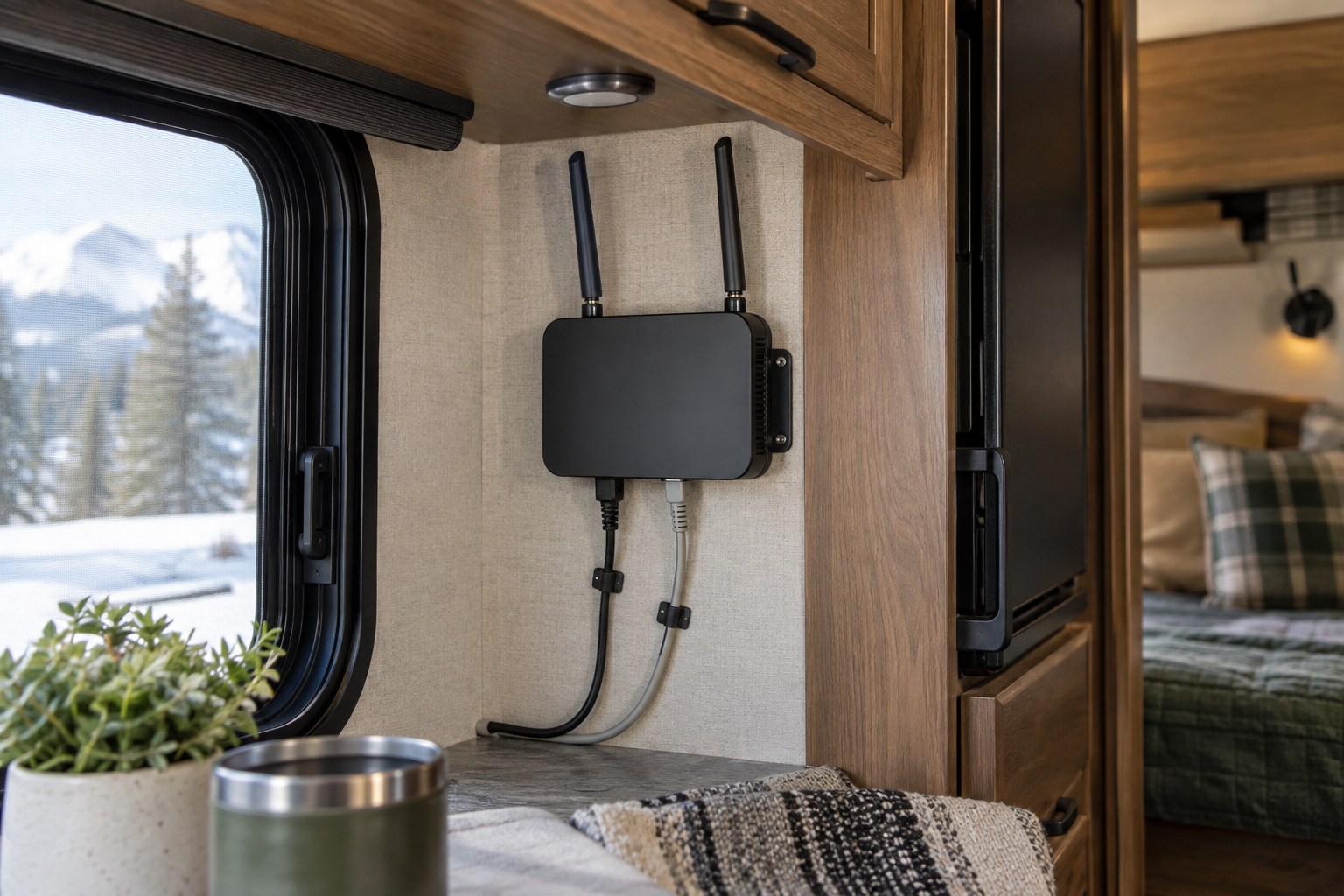
Then build your own:
- A cellular plan you have tested at that location. Check coverage maps for the actual park address before booking, on the carrier you use
- A second carrier, if your income depends on being online. Different carriers fail in different places
- A booster or external antenna if you are in a valley or under heavy tree cover. The North Country parks especially
- An answer to “what do I do right now”, a coffee shop, a library, a friend’s house within reasonable driving distance
Test all of it in the first two days, not on the morning of the call that matters.
Power, and the thing that catches people out
A work setup is not a heavy electrical load on its own. A laptop and a monitor draw very little.
The problem is what it shares the circuit with. In winter that is heating, and heating is the largest load you have.
Write down what runs at the same time. Heating plus the work setup. Heating plus the work setup plus the kettle plus the space heater you added in January because the mornings got hard. That last combination is the one that trips breakers, and it always happens mid-call.
Check the combinations against your rig’s limits and the amp service at your site. An adapter does not create amps, and resetting the same breaker three days running is a problem you have not solved. The winter RV camping guide goes through this properly.
Keep a charged power bank for your phone and a way to take a call if the power goes out. In a storm, that is not paranoia.
Heat, light and somewhere to sit
The three things nobody plans for and everybody complains about.
Heat. An RV heats unevenly, and where you work is often the coldest spot in it, a dinette against a large window is a beautiful place to sit and a cold one. Work out where you will actually be warm before you commit to a desk arrangement.
Light. It is dark by four thirty in December, and rigs are dimmer inside than houses. Get a decent lamp. A good one costs very little and changes the whole day.
A chair. This is the one. A dinette bench is fine for an hour and punishing for eight. If you are working a full winter, bring a real chair even if it costs you storage space. Everyone who has done this agrees, and everyone who has not thinks they will be fine.
Also: condensation. Two people breathing in a small space through a long cold day puts a lot of water in the air. Crack a vent, manage it daily, and keep it away from anything electrical.
Choosing the park for a working winter
Different priorities from a vacation.
Connection over scenery. A beautiful site with no signal is a bad office.
A road that gets plowed. If you have to be anywhere on a Tuesday morning, this matters more than anything on the amenity list.
Somewhere to go. Groceries, a coffee shop with a table, somewhere with a door you can shut for a call. Check what is within a sensible drive.
Packages. Ask what the park accepts and where. You will need it more than you think.
Quiet hours and neighbors. Mostly a bonus in winter. Worth asking anyway.
The parks near Boston work well if you need occasional office days. The North Country parks are quieter and harder on connection, check coverage properly before committing.
Stay length
Monthly usually fits this better than seasonal, unless you already know how the winter runs.
Ask whether electricity is billed separately on a monthly stay, because a work-from-home winter uses more of it than a park expects. Ask about renewal before you need it. And ask what happens if a contract ends and you want to leave early.
Our monthly or seasonal guide covers all of that.
What it is actually like
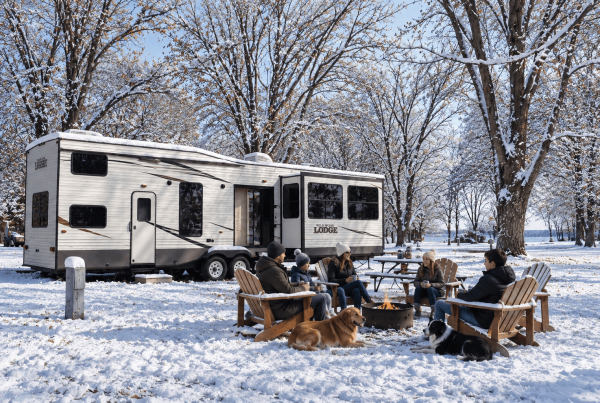
Up in the dark. Coffee while the rig warms up. Work at the table with snow coming down outside the window and nobody within a hundred feet of you.
Out at lunch, properly out, because the walk is right there and you will regret not taking it. Back in. Finish. Dark again by the time you close the laptop.
Then a fire, or the quiet, or a neighbor who has also been staring at a screen all day.
It is the same job. It is a considerably better place to do it.
Set up your winter office
Questions first? Contact Happy Grounds with your dates, rig length and what you need on site, or call (508) 519-3200.
Look at what is open, then call the park with your dates and ask the connection questions before anything else.
The commute is about four feet. Dress for it anyway.
WINTER CAMPSITE WORK SETUP CHECKLIST (PDF)
Frequently asked questions
Q: Is campground Wi-Fi good enough for video calls?
Sometimes, at some sites, on some days. Do not build your working life on it. Use your own cellular connection as the primary and treat park Wi-Fi as a backup, not the other way round.
Q: Can I run a space heater and work at the same time?
Depends entirely on your rig’s limits and the amp service at your site. Write down the combination and check it before you rely on it. A tripped breaker mid-call is the usual way people find out.
Q: Which Happy Grounds parks are best for remote work?
The ones near larger towns tend to have better cellular coverage and more fallback options. Check carrier coverage for the specific park address and ask the park what connectivity is like at the site you would book.
Q: Is a monthly stay better than seasonal for remote work?
Usually, unless your winter is already fixed. Monthly keeps you flexible if work changes, which it tends to.
Q: Can I get mail and packages at a winter campground?
Ask the park what it accepts and where it is held. It varies, and if you are working through the winter you will want it sorted before the first missed delivery.