

Every October the same thing happens. The rigs line up on I-95 and head for Florida, Texas or Arizona, and they do not come back until April.
It is the default. It is not the only option, and for a lot of people it is not the best one.
Here is the honest case for the other choice.
What the drive actually costs
Nobody adds this up properly, so let us do it.
From New England to the Gulf Coast is somewhere around fifteen hundred to two thousand miles each way. Call it a week of driving in each direction if you are sensible about it, more if the weather interferes. Fuel at whatever a heavy rig returns. Overnight stops on the way down and back. Wear on tires, brakes and everything that shakes loose over three thousand miles.
Then the site itself. Southern parks in season are not cheap, because everybody wants them at once, and the good ones are booked a year out by people who were there last year.
Then the things that are easy to forget. Two weeks of your life on the road. Being eighteen hundred miles from your doctor, your family and anyone who can look at your rig when something breaks. Coming back in April to a house or a storage lot you have not seen since autumn.
None of that makes snowbirding wrong. Plenty of people do the sums and go anyway, and they are right to. But do the sums.
What staying actually looks like
The version in people’s heads is a frozen rig on an empty gravel lot.
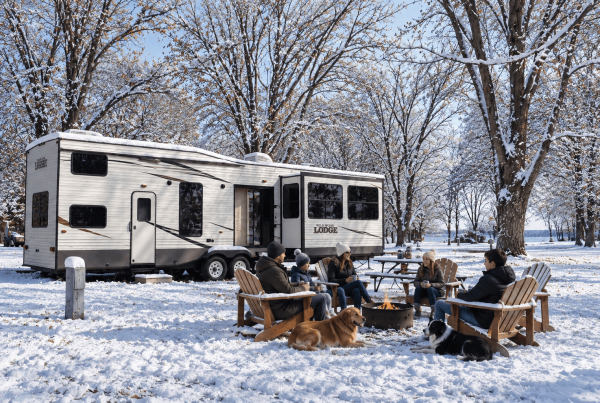
The reality at a park that runs a proper winter season is different. A winterized site with reliable power and water. Roads that get plowed. Neighbors who are still there in February because they also decided to stay. A rig you set up once in October and do not move until April.
You are an hour or two from home rather than two thousand miles. Your own doctor. Your own mechanic. Your grandchildren can drive over on a Saturday instead of flying.
And the cost of a seasonal site north is not a Gulf Coast in-season rate plus six thousand miles of fuel.
The part people do not expect to like
Winter parks are quieter, and the people in them are different.
A summer campground turns over every Friday. Someone new on every side of you, every weekend, all season. A winter park does not do that. The people on the sites either side of you in November are the people there in March.
That changes things. You learn names. Someone checks your rig when you are away for a week. Somebody organizes a thing on a Saturday because there is nothing else on. It is a neighborhood rather than a car park.
That is the part people come back for, more than the price.
What you genuinely give up
You give up warmth. Not “mild winter”, actual cold, for months, and some of it serious. That is not nothing.
You give up the easy version of outdoor living. Shorts in January, the pool, sitting outside without thinking about it. Winter camping outside is a deliberate act, not a default.
You take on preparation. Skirting, propane management, a water path you have thought about, an electrical load you have written down. The rig has to be genuinely ready and so do you.
And you take on some risk. Storms happen. Heating fails. Roads close. You need a plan for that, not an assumption that it will be fine.
If those things sound like reasons not to, that is a real answer and there is no shame in driving south.
Who it actually suits
From what we see across the parks, four kinds of people:
People with roots here. Family, grandchildren, a doctor, a house being sold. The ones for whom eighteen hundred miles is the cost, not the reward.
People who work. Winter work does not stop for a drive to Florida. A site an hour from the job is worth more than a palm tree.
People priced out of the south. In-season southern rates plus six thousand miles of fuel is a real number, and for some people it stopped adding up a few years ago.
People who actually like winter. They exist. Ice fishing, snowshoeing, a fire in the cold, a park where you can hear things. Some people were never going to enjoy a gravel pad in Arizona.
If you want to try it without committing to it
Do not sign up for a season on the strength of an article. Book two weeks in December and find out.
A short winter stay tells you more than any amount of reading: whether your rig holds heat, whether you can manage the propane, whether the dark at four in the afternoon bothers you, whether you like it. Then decide.
Our monthly or seasonal guide covers the commitment question properly, and the winter RV camping guide covers the preparation.
Stay
Questions first? Contact Happy Grounds with your dates, rig length and what you need on site, or call (508) 519-3200.
Look at what is open this winter, or call a park and ask what a season there actually involves.
Everyone else is on I-95. That is rather the point.
Frequently asked questions
Q: Is it cheaper to winter north than to snowbird?
Often, once you count fuel, overnight stops, wear and in-season southern rates. Work out your own numbers rather than either assumption, the answer depends on how far you would drive and where you would park.
Q: Can an RV handle a New England winter?
A properly prepared rig at a park with winter infrastructure, yes. A rig that was winterized for storage and then occupied without being brought back into service, no. The preparation is the variable, not the weather.
Q: What do you do all winter at a campground?
The same things you would do at home, plus ice fishing, snowshoeing and a fire. The honest answer is that a lot of it is ordinary life in a quieter place, which is rather the appeal.
Q: Do parks up north actually stay open?
Twelve Happy Grounds parks across Massachusetts, New Hampshire, New York and Vermont run winter seasons. Most campgrounds in the region do not.
Q: What does a seasonal winter site up north actually cost?
There is no honest single figure, because terms are quoted per park and per stay. Ask for a written quote for your exact dates, then compare it against your own drive-south arithmetic: the fuel, the overnight stops and the in-season southern rate.